

Does Gold Plated Jewelry Tarnish Easily? The Real Answer
Table of Contents
- Does Gold Plated Jewelry Tarnish Easily? What Actually Happens
- The Difference Between Tarnish and Plating Wear
- Why Gold Plating Wears Off: The Science Behind Tarnishing
- How Long Does Gold Plating Last on Everyday Pieces?
- Factors That Make Gold Plated Jewelry Tarnish Faster
- How to Clean Gold Plated Jewelry Without Damaging the Finish
- Best Practices for Jewelry Storage to Prevent Tarnishing
- DIY vs. Professional Re-Plating: What Works and What Doesn't
- Gold Plated vs. Solid Gold: What the Difference Means for Durability
- Frequently Asked Questions
Last Updated: September 24, 2026
Does Gold Plated Jewelry Tarnish Easily? What Actually Happens
Yes, gold plated jewelry can tarnish, and how quickly depends almost entirely on what sits underneath the gold layer. At Banabella, we work directly with certified manufacturers to produce 14K gold-plated eco-brass, and this is the question we hear most. Gold itself does not tarnish, but the base metals beneath the plating react with air, moisture, and skin oils, so some pieces stay bright for years while others dull within months.
The Difference Between Tarnish and Plating Wear
Tarnish and plating wear are two separate processes with two separate fixes, and confusing them leads people to clean jewelry that actually needs re-plating. Tarnish is a surface reaction: the base metal oxidizes or reacts with sulfur compounds in the air, producing a dull film. Plating wear is physical: the gold layer thins or rubs away, exposing the metal underneath.
Why Gold Plating Wears Off: The Science Behind Tarnishing
Tarnishing starts when the base metal reacts with its environment. The gold layer, when intact, is chemically stable and resists oxidation. Trouble begins at the edges, clasps, and contact points where plating is thinnest.
How Base Metals React to Air and Moisture
Copper and brass, the most common base metals, react with oxygen and sulfur compounds in the air, and moisture speeds that reaction up considerably. Humidity, sweat, and even water left on your hands after washing give it a head start.
How Long Does Gold Plating Last on Everyday Pieces?
There is no single lifespan, but there are reliable ranges. Plating thickness is the biggest variable: thin decorative plating measured in fractions of a micron can wear through in months with constant contact, while heavier plating measured in full microns can hold up for a year or more of regular wear.
Factors That Make Gold Plated Jewelry Tarnish Faster
Several everyday habits speed up tarnishing, and most are easy to change. Moisture, chemicals, and friction are the three biggest accelerators: the more of each a piece encounters, the faster the base metal reacts and the sooner the plating wears.
- Moisture: sweat, hand washing, and humidity all drive oxidation
- Chemicals: perfume, hairspray, sunscreen, and cleaning products attack the finish
- Friction: constant rubbing against skin, clothing, or other jewelry thins the plating
- Skin acidity: some people's natural skin chemistry reacts more aggressively with base metals
- Storage: pieces left loose in a drawer knock against each other and expose edges
Skin Acidity, Perfume, and Lotion
Skin acidity varies from person to person and genuinely affects how quickly a piece discolors. Some wearers see tarnish within weeks while others wear the same piece for a year with no change. This is not a defect; it is chemistry.
How to Clean Gold Plated Jewelry Without Damaging the Finish
The safest cleaning method for gold plated jewelry is a mild soap solution, a soft-bristle brush, and a microfiber polishing cloth. Skip ultrasonic cleaners and abrasive pastes entirely. They are designed for solid metals and will strip thin plating.
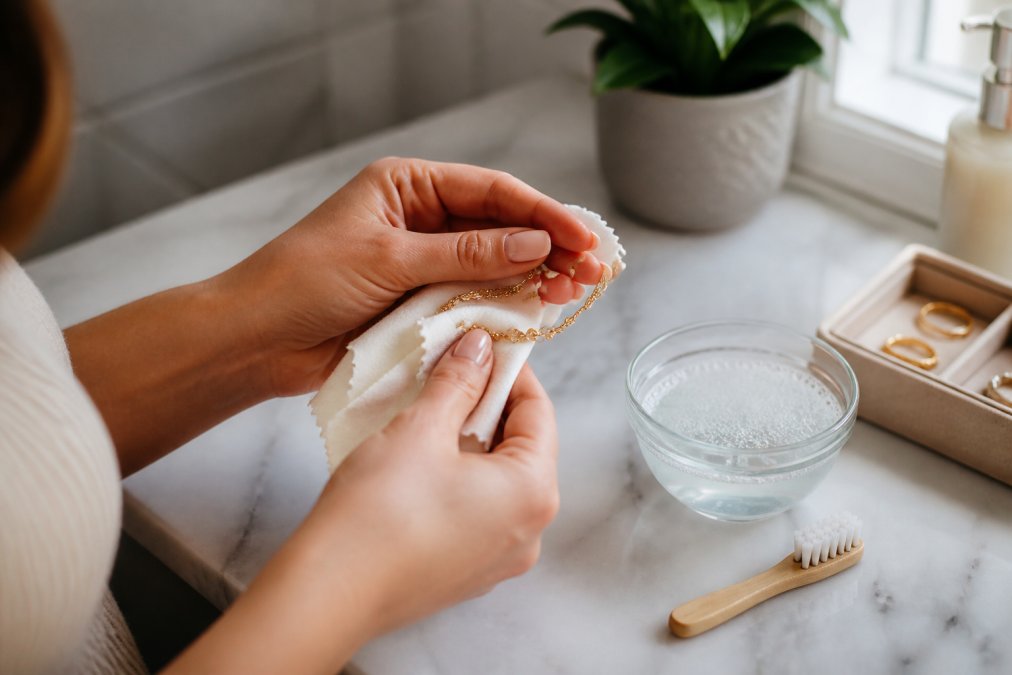
Follow these steps:
- Mix a few drops of mild dish soap into lukewarm water
- Dip a soft-bristle brush and gently work around clasps and edges
- Rinse briefly in clean water, never soak
- Pat dry immediately with a soft cloth
- Buff lightly with a microfiber polishing cloth to restore shine
What Not to Use (and Why)
Most cleaning damage comes from products people assume are safe. What to avoid, and why:
- Ultrasonic cleaners: High-frequency vibration can loosen or flake thin electroplated layers, especially at soldered joints and stone settings. They are formulated for solid metals, not micron-thin gold.
- Commercial jewelry dips: Many contain ammonia or sulfuric acid derivatives that dissolve copper and brass oxides, but they also attack the gold plating itself, leaving a chalky, dull surface that cannot be polished back.
- Toothpaste and baking soda: These are mild abrasives. On solid gold they remove tarnish; on gold plating they remove gold. A single vigorous brushing can wear through a flash-plated layer.
- Rubbing alcohol and acetone: These solvents strip the clear protective lacquer that some manufacturers apply over gold plating, accelerating tarnish once the barrier is gone.
- Hard water: Tap water with high mineral content leaves calcium and magnesium deposits that look like tarnish but are actually scale. If your water is hard, use distilled or filtered water for the rinse step.
How Often to Clean
If a piece has already tarnished beneath the plating, dark spots or a greenish tinge that does not wipe away, cleaning will not restore it. That is plating wear, not dirt, and it needs the re-plating discussion covered later in this guide.
Best Practices for Jewelry Storage to Prevent Tarnishing
Storage is the most underrated factor in jewelry longevity, and it is where the biggest gains are available. Air exposure drives tarnish, so limiting it is the goal. A tarnish-resistant pouch or a lined jewelry box with individual compartments does more for a piece than any polish.
The Humidity Threshold That Matters
Tarnish reactions accelerate sharply above roughly 60% relative humidity. Below 50%, copper and brass oxidation slows dramatically; below 40%, it is nearly negligible for short-term storage. Most homes sit between 40% and 60%, which is why a closed container alone is not enough, it traps whatever moisture was already inside.
- Silica gel packets absorb ambient moisture inside a closed box. Replace them when the indicator beads change color, typically every one to three months in humid climates.
- Anti-tarnish strips work differently. They are usually impregnated with activated carbon or copper-impregnated polymers that adsorb sulfur compounds, the gases that cause silver and copper to darken. They do not absorb moisture, so pair them with silica for full protection.
- Airtight containers (gasketed boxes, zip-top bags with the air pressed out) limit fresh air exchange. A standard jewelry box with a loose lid is not airtight; it just slows air movement.
A Storage Setup That Actually Works
You do not need expensive equipment. A practical setup for everyday gold plated jewelry:
- Individual pouches: Store each piece in its own anti-tarnish pouch or a small zip-top bag. This prevents friction scratches and isolates any piece that starts to tarnish.
- A sealed outer container: Place pouches inside a gasketed plastic or glass container. Press out excess air before sealing.
- Moisture control: Add one silica gel packet per container. In humid climates, add a second and check monthly.
- Sulfur control: Add one anti-tarnish strip per container if you also store sterling silver or copper-heavy pieces.
- Location: Keep the container in a cool, dark, dry spot, not a bathroom, not above a radiator, not in direct sunlight. Temperature swings cause condensation inside sealed containers.
What Not to Do
- Do not store jewelry in an open tray on a dresser. Dust, humidity, and sunlight all accelerate tarnish.
- Do not hang necklaces on a wall hook. Air exposure is constant, and gravity stresses the chain over time.
- Do not store pieces loose together. Metal-on-metal contact rubs plating off at contact points.
- Do not use paper envelopes or cardboard boxes for long-term storage. Paper and cardboard can contain sulfur compounds that actively promote tarnish.
In a humid climate or near the coast, storage discipline matters even more: salt air and high ambient moisture push the reaction faster than almost any other environmental factor. Check silica packets monthly and replace them at the first sign of saturation.
DIY vs. Professional Re-Plating: What Works and What Doesn't
DIY re-plating kits exist, and for small touch-ups on costume pieces they can work. For anything you care about, they usually make things worse.
Here is how the two compare:
| Approach | Best For | Main Drawback | Result Quality |
|---|---|---|---|
| DIY cleaning | Routine maintenance | Can strip plating if abrasive | Preserves existing finish |
| DIY re-plating kit | Cheap costume pieces | Uneven, flakes quickly | Unreliable |
| Professional re-plating | Sentimental or valuable pieces | Cost may exceed item value | Near-original finish |
| Replacement | Everyday affordable pieces | None, if you buy quality | Fresh, intact plating |
Gold Plated vs. Solid Gold: What the Difference Means for Durability
Solid gold does not tarnish, because there is no base metal to react. Gold plated jewelry can tarnish, because the base metal beneath the gold layer is exposed the moment the plating wears thin.
Frequently Asked Questions
How long will gold-plated jewelry last?
Gold-plated jewelry typically lasts six months to two years with daily wear, depending on plating thickness and how well you care for it. Pieces with thicker plating (2.5 microns or more) and a protective coating last longer. Removing jewelry before showering, swimming, or applying lotion extends its life significantly. With careful storage and gentle cleaning, some pieces hold their finish for several years.
Can I take a shower with gold-plated jewelry?
It's best to remove gold-plated jewelry before showering. Water, soap, and shampoo gradually break down the thin gold layer and speed up oxidation on the base metal underneath. Chlorine in pools and hot tubs is even harsher. If you want jewelry you can wear in water without worry, look for solid gold or high-quality stainless steel pieces instead.
Does 14K gold-plated jewelry rub off?
Yes, 14K gold plating can rub off over time, but it wears more slowly than cheaper 18K or 24K plating because 14K gold is harder and more durable. Friction from daily wear, especially on rings and bracelets, is the main cause. Plating thickness matters more than karat for longevity. A thicker 14K layer with a protective coating resists wear far better than a thin one.
How can I restore tarnished gold-plated jewelry?
For light tarnish, wipe the piece with a soft polishing cloth and mild soapy water, then dry it completely. Avoid abrasive cleaners or ultrasonic machines, which strip the gold layer. If the plating has worn through to the base metal, home fixes won't restore the color. Professional re-plating is the only reliable option at that point, and it's often worth it for pieces you love.
What is the difference between gold-plated and gold-filled jewelry?
Gold-plated jewelry has a thin gold layer applied over a base metal like brass or copper, usually less than 2.5 microns thick. Gold-filled jewelry bonds a much thicker layer of gold (at least 5% of the total weight) to the core, making it far more resistant to tarnishing and wear. Gold-filled costs more but lasts years longer, which matters if you wear the piece daily.